A Project by Peyton Murrell

About The Project
This web page was started in conjunction with a scholarship opportunity with DISC. I wanted to build a tool to help teams understand and work through the process of Team Choice Elements (TCE's). They can be some of the most rewarding... and stressful... work you do on your solution. What is a team choice element? How do we go about coming up with ideas for them? How will we be scored? Is it really that important? What makes a good TCE? I will try to answer these questions here. I hope you come away with a little more knowledge than you had when you clicked on this link.
What are Team Choice Elements?
Below, is the formal definition of what a team choice element is. In a nutshell, a team choice element is something you have decided to include in your solution that showcases team members' strengths while enhancing the overall skit.

Understanding Team Choice Elements
A good Team Choice Element is ageless.
As with any other part of your solution, it is important to understand where your points are coming from. The pie chart below shows the overall points structure of a central challenge. Team choice elements account for 15% of your overall score. So, to answer the question, "Are they really important?" That answer is YES! That 15% could be the difference between going to state or global finals. There are three categories where you will be scored for team choice elements: 1. Creativity and originality (Up to 10 pts) 2. Quality, workmanship, or effort that is evident (Up to 10 pts.) 3. Integration into the Presentation (Up to 10 pts.). Each TCE is worth up to 30 points each, for a total of 60 points. Team choice elements are the place in your solution where you can let your hair down and really branch out to showcase your team's strengths. So how can you figure that out? Easy! Ask each other what you like to do. You might have someone on the team who has been painting for years and can make amazing portraits. Someone else might be incredibly strong with electronics and can figure out a way to make an electric piano play a favorite song.
It is important to make sure that, whatever you choose, the TCE must be integrated in to your solution. Just because you can make an awesome hover craft that can carry a team member across the floor, it will not get many points if it has no meaning to your story.
Sometimes teams will structure their entire solution off of their team choice elements. There have been team members before who come in to the first meeting of the season and say, "Hey, I want to build a rotating carousel that can be ridden on." The team loves the idea and build their solution around the carousel. What makes a good team choice element? Anything that your team feels is an important part of their solution and that hits those three scoring components while being well-integrated into their skit will be a success. Just remember: as with the majority of scoring items in a solution, these scores are subjective and will be scored according a rubric. We may not always agree with what the appraisers score our hard work, but that is ok. You take their scores and build for the future. It is always a great idea to go and watch other teams in different challenges. Ideas can spark just about anywhere.
In the next section you will find different categories that team choice elements often fit into. The list is by no means comprehensive. Rather, it shows off the four most common types of team choice elements.

Categories
A team choice element is something that a team will spend quite a bit of time working on. It will not only be important to the team but to the overall presentation. Because of that, team choice elements typically fall into a few categories. These categories, explained in more detail below, all contain creations that are integral to a team's presentation or solution. Once you get a good feeling for some of the common types of team choice elements, feel free to look through the gallery of TCE's in the next section. There, you'll see a wide range of creations from all different levels of competition.

Backdrops
Backdrops are a common item to use as a team choice element. It is easy to identify, it can house a series of items that lend themselves to your solution, and it is easily integrated into your skit. There are countless ways to create backdrops. From cardboard to PVC to foam board, the world is your oyster when it comes to creating backdrops. The downside to using a backdrop is that it is typically a large item. Know that you do not have to use the entire backdrop if you feel there is a particular piece of it that is extraordinary. For example: your backdrop is a picture of a cottage, painted within the forest. Although it looks nice, it is not as integrated as the 3-D wishing well that is built out of the side of the backdrop and is used as a focal point throughout the skit.

Costumes
Costumes bring your characters to life. Teams can be as simple or elaborate as they choose with costumes. What is most tricky about choosing costumes is that most of the time, a team will put “costumes” down on their tournament data form. That means that the appraisers will look at every costume used in your solution. Now, Susie may have gone to the Goodwill and picked up an old Halloween costume to wear. Johnny made the hat that he is wearing as he plays Farmer Brown. And then there’s Sally: she spent three weeks learning how to sew and made a dress and apron to help her portray the farmer’s wife. While that hand sewn dress may be extraordinary, the score may be brought down by the other two costumes. Don’t forget the scoring components of a team choice element, and really look closely at what you are putting down on your tournament data form. I have been told before, if you are going to be in costume, do it all the way. From the top of your head to the bottom of your feet, become that character.

Technical Elements
When considering a team choice element, you will want to step outside of your comfort zone and really tap into areas that may or may not be a strength for you and your team. Technical additions to a solution always bring an element of surprise and excitement. If you have a team member who is on the school’s robotics team, perhaps he can build something that will integrate well into your solution. There are countless ways to bring technical effects into your skit. Always read the Rules of the Road to make sure that what you are dreaming up is allowed.
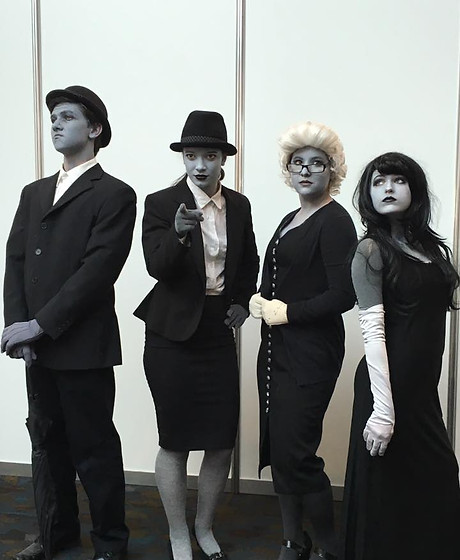
Miscellaneous
Team choice elements can span as far as your imagination can take you. As long as it is not something that is already being scored in your solution, you are free to create anything that heightens your skit. It can be small or large, include one team member or the entire team, be extremely intricate or very simplistic and straightforward. As long as it enhances your solution and falls within the rules, you are free to create anything your heart desires.


About Me
Hello! I’m Peyton Murrell, and let me preface this section by thanking you for visiting this web-page. I really hope this page has been able to provide you with some new information or inspiration. My involvement with DI started back in 2009 whenever my team began working on the structure challenge “Breaking DI News”. In that year, I knew DI would end up being one of my favorite programs. After competing for a few years, our team eventually made it to high school where we found our favorite challenge: Project Outreach (Service Learning). Within that time-span, we had competed in all of the main challenges, earning the Magellan Award. Since graduating, I’ve volunteered with my region taking pictures and coming up with our pin and shirt designs. I am also an avid pin trader and collector (you can often spot me on Facebook pages or at different competitions trying to make some trades). I can’t wait to continue to work with the program and see what DI has in store for the future.
“Creativity is contagious, pass it on”
– Albert Einstein

